
Brass Jewelry Manufacturing: Why Plating Does the Work
Plating is the step customers judge and the step manufacturers most often describe in one word. On brass it is a deposition process that copies the surface underneath it, which is why the published eight-step flow puts polishing and surface art before electroplating rather than after. The brass MOQ of 100 pieces per design buys that sequence, and the coating is required to be 100% compliant with REACH and CA Prop 65.

Key takeaways
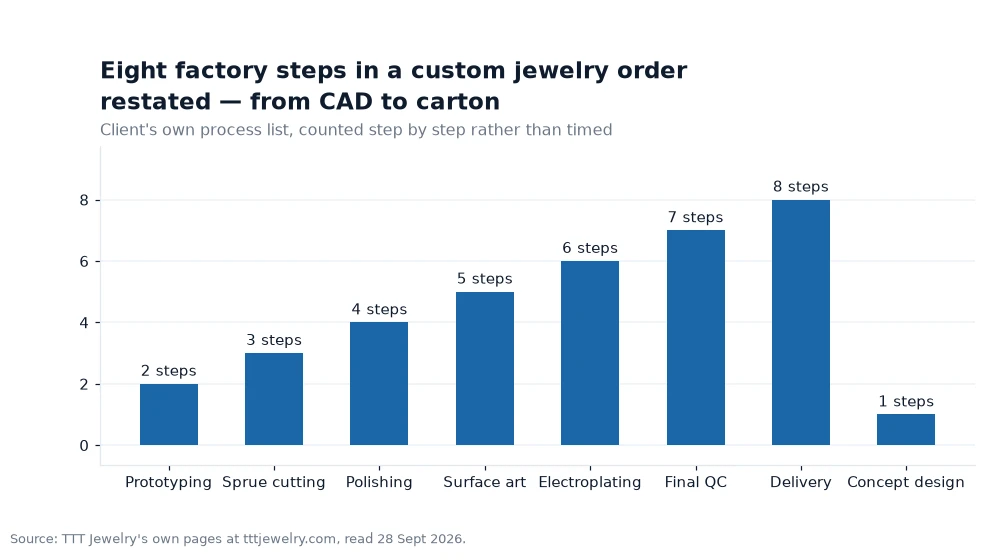
- The published flow runs eight steps, with electroplating sixth — after sprue cutting, high-gloss polishing and surface art.
- Brass takes multi-layer 14K, 18K or 24K gold, rhodium, and an anti-tarnish e-coating; stainless takes PVD instead.
- Brass MOQ is 100 pieces per design, and every piece passes 100% final inspection.
- CAD is quoted at under 48 hours, so 2 days against a 25–30 day sampling window.
Plating copies the surface beneath it
Electroplating deposits metal from a bath onto a conductive surface. The deposit is thin, so it does not level a scratch or round off a tool mark; it follows the topography it lands on and makes it slightly more visible once light hits the coating. A scratch that reads as a faint line on raw brass reads as a bright line once gold sits over it.
This is the logic behind the published order of operations. Sprue cutting removes the casting gate. High-gloss polishing removes the marks left by the cut. Surface art then applies the brushed or textured effect on purpose, so that any texture in the finished piece is a decision rather than a residue. Only then does electroplating go on.
Reverse the order and the economics change. A defect discovered after plating cannot be polished out without stripping the coating, and stripping means re-polishing and re-plating the piece. At that point the cost is not the gold; it is the second pass through a sequence that was already scheduled.
Eight steps, one coating
The published factory sequence is concept design, prototyping, sprue cutting, polishing, surface art, electroplating, final QC and delivery. Read against that list, plating is one step out of eight, but it is the step that determines how the other seven are perceived.
| Finish | How it is applied | Base material | Care implication |
|---|---|---|---|
| Multi-layer 14K gold | Electroplated layers over a prepared surface | Brass, sterling silver | Keep away from abrasives and chlorine |
| Multi-layer 18K gold | Electroplated layers, warmer tone | Brass, sterling silver | Colour reads warmer under retail light |
| Multi-layer 24K gold | Electroplated layers, deepest yellow | Brass, sterling silver | Softest colour match to fine jewellery |
| Rhodium | Electroplated white finish | Brass, sterling silver | Bright white; wears as a surface layer |
| Anti-tarnish e-coating | Applied over plating as a barrier | Brass, sterling silver | Slows tarnish and limits skin contact |
| PVD vacuum plating | Vacuum deposition, not a bath | Stainless steel | Suits shower-safe, swim-proof wear |
Two rows in that table matter more than the rest for a brass buyer. The gold tones are a colour family, and choosing between 14K, 18K and 24K is a merchandising decision that should be made once and written down. The e-coating is a performance decision, and it is the reason a brass piece can be sold as everyday wear rather than occasional wear. The PVD row belongs to a different process entirely: stainless steel takes vacuum plating rather than a bath, which the stainless steel jewelry manufacturer page describes as the route for shower-safe pieces.
Brass and the barrier question
Brass is a copper-zinc alloy, and copper reacts with moisture and air. The coating stack is therefore doing two jobs at once: it supplies the colour, and it supplies a barrier. The published anti-tarnish e-coating sits on top of the plating as the outer barrier, which matters most at the points that touch skin — the inside of a ring band, the post of an earring, the underside of a pendant.
Compliance runs alongside that. The published statement is REACH compliance with plating 100% compliant with REACH and CA Prop 65, free of lead, cadmium and nickel. For a brand selling into Europe or California, the useful evidence is not the claim itself but the paperwork attached to the production lot.
Care guidance is part of the coating specification, not a dispatch afterthought. If a finish is built for occasional wear, the label should say so; if a piece is sold as everyday wear, the e-coating should be named on the care card. A retailer's compliance team will also want the coating route traceable to a production lot, and a care card that matches the inspection record is the simplest form of traceability to produce.
There is a practical limit worth stating plainly. A coating slows tarnish and reduces direct contact; it does not make brass waterproof. Care instructions should say so, and the packaging should not promise more than the coating can deliver.
What a plating quotation should name
Ask for four things in writing: the coating sequence by layer, the colour standard the finish is matched to, the surface preparation step that precedes the bath, and the inspection point after coating. A quotation that lists plating without naming the polish stage is quoting an unfinished process.
This is where the difference between a trading desk and a wholesale brass jewelry factory becomes visible. The factory can describe the sequence because it runs the sequence; a desk can only repeat the finish name. The same question about inspection usually settles the matter, since 100% final inspection means every piece is handled, not a sample from the lot.
Colour standards are the second test. A buyer should be able to hold the approved master beside a production piece and see the same tone under the same light. If the standard is verbal, it will drift between lots. That single habit — a physical standard held by both sides — does more for a custom brass jewelry programme than any clause about coating thickness.
Worked example
Use the published windows to see where the time actually sits. CAD takes under 48 hours, so 2 days. Sampling takes 25–30 days. Bulk takes 3–4 weeks, or 21–28 days. The full path is 2 + 25 + 21 = 48 days at the fast end and 2 + 30 + 28 = 60 days at the slow end.
Now express sampling as a share of the total. At the fast end, 25/48 = 52% of the calendar is sampling. At the slow end, 30/60 = 50%. Half of the project is the approval loop, which is why a plating colour rejected at the master stage is expensive: it re-enters the half of the schedule that carries the most days.
The CAD share tells the opposite story. At 48 hours against a 25-day window, CAD is 2/25 = 8%; against a 30-day window the same 2 days work out at 2/30 = 6.7%. Design work is a small slice of the clock, so it should not be rushed to save time; the days are in the sample, not the file.
Frequently asked questions
Why is polishing done before plating?
Because the deposit copies the surface: polishing at step four removes tool marks that plating at step six would otherwise preserve and make more visible.
Does gold plating on brass wear off?
It wears as a surface layer over time; the published brass route uses multi-layer gold plus an anti-tarnish e-coating to slow that wear, and care advice should reflect it.
Can brass and stainless steel share a plating line?
No: brass takes electroplating, while stainless steel takes PVD vacuum plating, so a mixed collection needs two processes and two approval standards.
Reading a plating quotation
The last question to settle is ownership of the master, because a colour standard that lives only at the factory is a standard the next order cannot meet. A quotation is useful when it names the sequence rather than the colour: preparation, coating, barrier and inspection, four lines a buyer can compare across suppliers. Where a collection spans metals, keep the approval documents separate, since the 50-piece threshold on the sterling silver jewelry manufacturer page is a different commitment from a brass run. If the approved sample sits with both sides, the next order starts from evidence rather than from memory.
Source note: figures come from the manufacturer's own website (tttjewelry.com), read 28 Sept 2026.[1]